
Traveler’s Story
Above the Ice:
Visiting Glacier Lookout
By Alex Long, Seed Media
As we ascend toward West Peak by helicopter, I’m already framing shots through the cabin door. Three thousand feet below, icebergs gleam in the midday sun; braided streams of glacial runoff unravel like fine silver threads out to Valdez Arm. I feel as if I’m looking back in time, witnessing the slow conversation between ice, mountain, and sea that shaped this extraordinary landscape.
When we touch down, the wind stills and a quiet settles over the ridge. Before me stands Glacier Lookout, a handcrafted 1930s-style fire tower perched 3,600 feet above Valdez Glacier. Sunlight filters through wraparound windows, warming the cozy cabin interior.
The lookout’s creator, backcountry guide and craftsman Zachary Sheldon, shows me around with the calm of someone who belongs to the mountains. Since 2015, he has called Valdez home, building this retreat nearly by hand, one board at a time.
“I love exploring Alaska—not just for myself, but to help others connect to it in a real way,” Sheldon says. Staying at the lookout means stepping into something he created for those who want to feel Alaska not as an image on a postcard, but as a lived experience. With his knowledge of the land and deep respect for its beauty, visitors like myself experience the comfort of having an expert by their side in a setting that feels both remote and accessible.
A talented photographer himself, Zach shares tips on where to find the best angles. He tells me that as the day progresses, snowmelt from above will trickle down and fill the shallow gully alongside the lookout, becoming a steady stream by evening. I set up a timelapse to capture the event, while he heads off to work on the construction of a guide cabin beyond a nearby ridge.
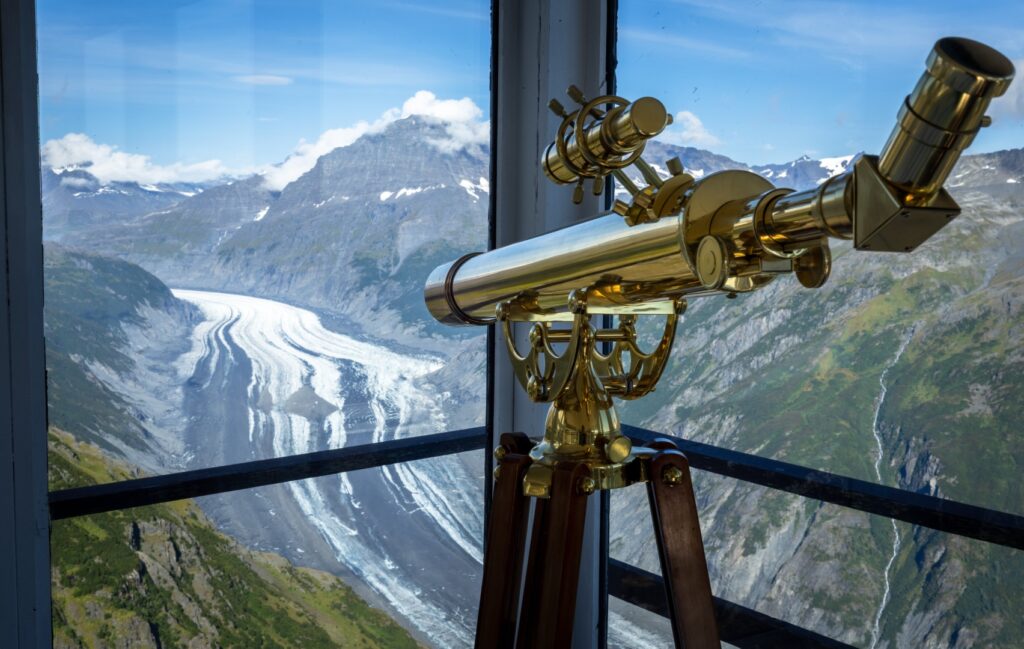
From the lookout, the world expands in every direction—the glacier gleaming in blue tones, mountains receding like waves. There’s no Wi-Fi, no hum of civilization, only the hush of wind and the slow pulse of meltwater. I don’t stay overnight, but even in a few hours, something shifts. The stillness here redefines solitude: not emptiness, but presence.
I imagine the night unfolding with stars unbroken by city glow, or the northern lights rippling across the ice; I imagine sunrise spilling across the eastern peaks, a luminous cloudscape flowing through the valley below—moments that would feel less like seeing and more like remembering what it means to simply be.
Near the end of my visit, Zach finds me and points upslope. I see it: a wolverine darting across a sunlit snowfield—dark, quick, vanishing into the white. Even as a lifelongAlaskan accustomed to bears, moose, and orcas, I’m enthralled to finally catch sight of one of these elusive creatures. The lookout seems to invite such moments—glimpses of wild beauty that feel wholly personal.
On the flight down, my pilot, Al Carbono—who grew up in Panama and later lived in Hawaii—remarks that he’s found nowhere better than Valdez, neither for its land nor its people. I watch the ridge where Zach is still at work recede, the glacier below folding into light and shadow. He’s right. This is what makes Valdez singular: not only its wild, varied terrain, but the community that has chosen to root itself here. Within a small radius of town, mountains meet sea, glaciers meet rainforest, and people embrace the wilderness in a harmony that distills Alaska at its best.
By Alex Long, Seed Media